
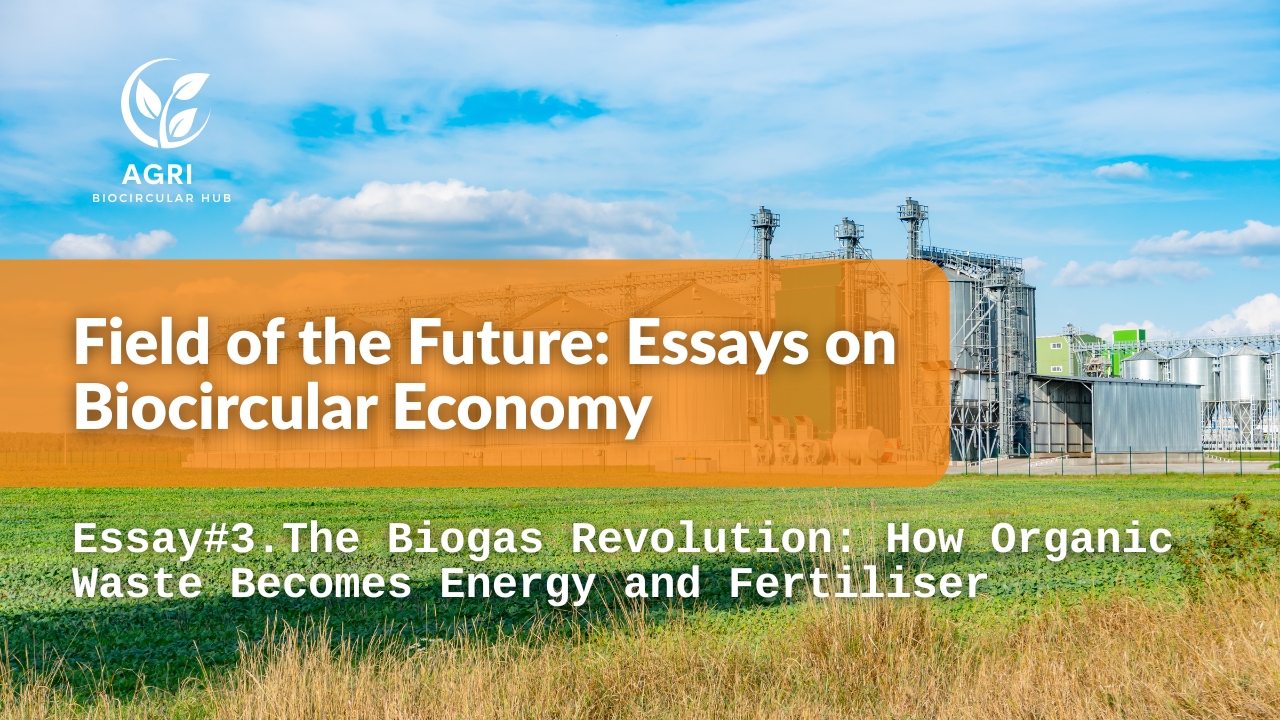
The Biogas Revolution: How Organic Waste Becomes Energy and Fertiliser

There is a moment in the operation of an anaerobic digestion plant that captures the essence of the bio-circular economy more precisely than any policy document can. Organic material enters the system: manure, crop residues, food waste, sewage sludge. Microorganisms break it down in sealed tanks, in the absence of oxygen. What comes out the other side is not waste. It is two distinct, commercially valuable products: biogas, which can generate electricity, heat, or be upgraded to biomethane for grid injection, and digestate, a nutrient-rich slurry that functions as a high-quality biofertiliser.
Nothing is discarded. The farm’s waste stream becomes its energy supply. The energy process produces the farm’s fertiliser. The fertiliser feeds the soil that grows the next harvest. This is not a metaphor for circularity. It is circularity in operation, measurable and scalable, and it is already happening across Europe at significant scale.
The Numbers Behind the Revolution
Europe’s biogas sector has grown steadily into one of the most significant components of the continent’s renewable energy and circular bioeconomy infrastructure. The scale of what already exists is often underappreciated.
Europe closed 2024 with 1,620 biomethane-producing facilities across 25 countries, generating 22 billion cubic metres of biogas and biomethane combined. This is equivalent to the entire inland gas demand of Belgium, Denmark, and Ireland together, covering approximately 6% of the EU’s total natural gas consumption. The fastest-growing segment, biomethane, reached 5.2 billion cubic metres of production, supported by an installed capacity of 7 billion cubic metres per year across the continent.
22 billion m³ total biogas and biomethane production in Europe in 2024, covering 6% of EU gas consumption (EBA, 2025)
Germany remains the largest single market, operating over 9,500 biogas plants generating 10 billion kilowatt-hours of electricity annually, roughly 7% of the country’s total electricity supply. The European biogas plant market was valued at 1.37 billion US dollars in 2024 and is projected to reach 2.88 billion dollars by 2033, growing at 8.6% annually. Private investment committed to biomethane development ahead of 2030 already stands at 28.4 billion euros.
EUR 28.4 billion in private investment already committed to European biomethane development ahead of 2030 (EBA, 2025)
The feedstock driving this growth is predominantly agricultural. Agricultural residues represent 45.4% of all European biogas plant inputs. Manure alone, if fully mobilised, could generate approximately 280 billion cubic metres of biogas globally, according to the IEA, averting one billion tonnes of CO₂-equivalent emissions in the agricultural sector.
How It Works: The Full Circular Chain
The process at the core of biogas production is anaerobic digestion: the breakdown of organic matter by microorganisms in oxygen-free conditions. Understanding the full chain of outputs from this process helps explain why it is regarded as one of the most practical circular technologies available to agriculture today.
Step 1: Feedstock input. Agricultural by-products enter the digester: livestock manure, crop residues, food processing waste, sometimes combined with municipal organic waste or sewage sludge. The combination of feedstocks, known as co-digestion, can significantly increase biogas yields and make operations economically viable at smaller scales.
Step 2: Biogas production. Microorganisms break down the organic material, producing a gas mixture of primarily methane and carbon dioxide. Raw biogas can be burned directly for heat and electricity generation on the farm or in a combined heat and power (CHP) unit. Alternatively, it can be upgraded by removing the CO₂ to produce biomethane, which is chemically identical to natural gas and can be injected directly into the gas grid, used as vehicle fuel, or converted into hydrogen, methanol, or syngas for industrial applications.
Step 3: Digestate recovery. After digestion, the remaining material is digestate: a nutrient-rich slurry containing the nitrogen, phosphorus, and potassium from the original organic inputs, now in forms that are more readily available to plants than in raw manure. Europe produced 25 million tonnes (dry matter) of digestate in 2024. Applied to agricultural land, it functions as a biofertiliser, improving soil structure and reducing the need for synthetic chemical inputs.
Step 4: Biogenic CO₂ capture. When biogas is upgraded to biomethane, the separated CO₂ stream, biogenic in origin, can be captured and used commercially: in greenhouse horticulture to accelerate plant growth, in the food and beverage industry, for the production of e-fuels, or stored as a carbon removal mechanism. What was previously vented to the atmosphere becomes a tradeable product.
The result is not a single output but a cascade of value: energy, fertiliser, carbon, and potentially hydrogen, from a single input stream that agriculture generates as an unavoidable by-product.
The Fertiliser Dimension: Reducing Import Dependence
Of all the outputs from anaerobic digestion, digestate may prove to be the most strategically significant in the medium term. Europe’s dependence on imported synthetic fertilisers is a documented vulnerability. In 2024, the EU imported 24.2 million tonnes of fertilisers, of which 11.2 million tonnes were nitrogen-based, predominantly derived from natural gas through the Haber-Bosch process.
Current biogas production already generates 3 million tonnes of home-grown nitrogen-based organic fertiliser annually, covering approximately 17% of the EU’s current nitrogen fertiliser demand. With projected sector growth, digestate could substitute over 65% of non-renewable nitrogen in the EU by 2040, according to EBA projections.
65% of EU non-renewable nitrogen fertiliser demand could be substituted by digestate by 2040 as the sector scales (EBA, 2025)
This is not only an environmental gain. It is a matter of economic resilience and strategic autonomy. Fertiliser prices are directly linked to natural gas prices and to the geopolitical stability of producing regions. A domestic, bio-based alternative that is generated as a co-product of waste management reduces exposure to these external risks while simultaneously improving soil health over time.
The regulatory framework for digestate is still catching up with its potential. In much of the EU, digestate is legally classified as a residue rather than a product, which imposes additional permitting requirements and limits its commercial uptake. Portugal’s decision in May 2025 to reclassify digestate as a product rather than waste marks a significant precedent that, if adopted more broadly, could unlock the full commercial value of this resource across European agriculture.
Poland, Latvia, Ukraine: Three Pathways
The biogas transition looks different in each country where AGRI-BIOCIRCULAR-HUB operates, reflecting different starting points, regulatory contexts, and resource bases. These differences are instructive.
In Poland, the biogas sector reached a milestone in 2025 when the country injected its first biomethane into the national gas grid. This came after years of infrastructure development in which institutions such as Poznan University of Life Sciences played a central role, operating some of Europe’s most advanced composting and biogas research facilities. Poland has substantial agricultural feedstock: 14.8 million hectares of agricultural land, significant livestock populations, and an established tradition of mixed farming in regions like Wielkopolska. The challenge now is connecting this resource base to the processing and grid infrastructure that allows the value to be captured.
In Latvia, the approach has been built around specific agricultural sectors. The Egg Energy facility, a partner in the AGRI-BIOCIRCULAR-HUB Latvian ecosystem, demonstrates how poultry farming by-products can anchor a viable biogas operation. Poultry manure is a high-yield biogas feedstock, and when combined with the deep-tech commercialisation infrastructure provided by the Commercialization Reactor and the sector networks of the Latvian Biogas Association, it illustrates how a single-sector resource stream can be built into a functioning circular value chain. Latvia is also among the European countries producing liquefied biomethane (bio-LNG), reflecting the maturity of its approach to biogas valorisation.
In Ukraine, the picture is one of significant potential and an accelerating trajectory. Ukraine joined the group of European countries producing biomethane in 2023. The country possesses vast agricultural residue streams, extensive livestock operations, and, critically, a policy environment increasingly oriented toward European integration and the adoption of EU environmental standards. The bio-circular work coordinated by Lviv Polytechnic, in partnership with municipal enterprises and regional administration, reflects an understanding that biogas and bio-based waste management are not peripheral activities but core infrastructure for a sustainable post-war reconstruction.
The Biorefinery Model: Beyond Single Outputs
The most significant conceptual shift in how biogas plants are understood and designed is the move from single-output energy facilities to multi-product biorefineries. A modern biogas operation produces not just electricity or grid gas but a portfolio of outputs: biomethane or biogas for energy, digestate for agriculture, biogenic CO₂ for industrial use, and potentially biochar as a soil amendment and carbon storage medium.
This portfolio approach changes the economics fundamentally. When digestate is counted as a revenue stream rather than a disposal cost, when biogenic CO₂ is captured rather than vented, when biochar is produced and sold rather than discarded, the financial case for biogas investment strengthens considerably. The European Commission’s November 2025 Bioeconomy Strategy explicitly recognised biogas plants as biorefineries and called for policy frameworks that support the full valorisation of all co-products, including regulatory adjustments to allow digestate to be traded as a biofertiliser product rather than managed as a waste residue.
This is where AGRI-BIOCIRCULAR-HUB’s work on pilot projects and cascade funding for SMEs is directly relevant. Many of the innovations that unlock additional value from biogas processes, whether digestate processing technologies, CO₂ capture systems, or biochar production, are being developed and commercialised by small and medium-sized enterprises. Connecting these innovators to the farms and processing facilities that can use their solutions, and providing the mentoring and funding pathways that allow them to reach commercial scale, is precisely the gap that a project of this kind is positioned to fill.
A Proven Technology at an Inflection Point
Biogas and anaerobic digestion are not emerging technologies awaiting proof of concept. They are proven, commercially deployed systems operating at industrial scale across Europe. What stands between current deployment and the full potential of this sector is not technical uncertainty but a combination of regulatory friction, infrastructure gaps, and the absence of the connections that allow individual farms and enterprises to participate in circular value chains.
The 2040 projection of digestate covering 65% of EU non-renewable nitrogen demand is not speculative. It follows logically from the continued scaling of a sector that is already growing, already investable, and already generating value across the full chain from waste input to energy and fertiliser output. The question is not whether this transition will happen but how quickly, and whether the farms, communities, and enterprises in Poland, Latvia, Ukraine, and across Europe will have the networks and support to participate in it when the opportunity arrives.
The waste that enters an anaerobic digester today is the energy and the fertiliser of tomorrow. That is not a slogan. It is a description of a process that is already running.
This essay is part of the series Field of the Future: Essays on Biocircular Economy, published within the AGRI-BIOCIRCULAR-HUB project. Funded by the European Union under Horizon Europe (Grant Agreement No. 101186869). Data sources: European Biogas Association Statistical Report 2025; IEA Outlook for Biogas and Biomethane 2025; European Commission Bioeconomy Strategy 2025; World Biogas Association; Eurostat.