
AGRI-BIOCIRCULAR-HUB Passes Its First Project Review: Foundations Laid, Large-Scale Deployment Ahead

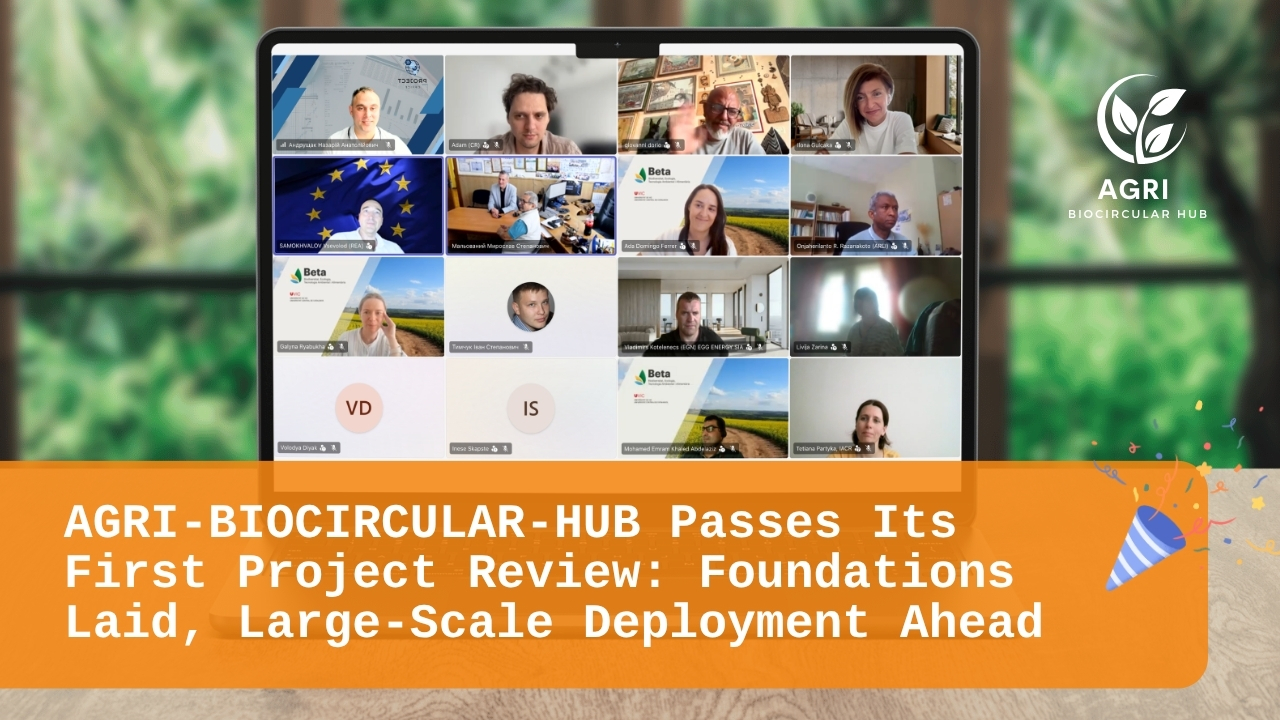
On 19 June 2026, the AGRI-BIOCIRCULAR-HUB consortium (Grant Agreement No. 101186869, HORIZON-WIDERA-2023-ACCESS-07) held its first official project review — Periodic Reporting #1, covering the first fifteen months of implementation (M1–M15). The four-hour online meeting brought together representatives of all 21 partners from five countries: Ukraine, Poland, Latvia, Spain and Belgium.
The review was conducted by Vsevolod Samokhvalov, Project Officer at the European Research Executive Agency (REA), and Dr Giovanni d’Orio, Professor of Economic Policy at the University of Calabria, who acted as the independent external monitoring expert. The project is coordinated by Lviv Polytechnic National University (LPNU).
We are sincerely grateful to both evaluators for a constructive dialogue and for their positive feedback on the work delivered so far — and to the entire consortium for its dedicated, coordinated effort throughout this period.
About the project
AGRI-BIOCIRCULAR-HUB is a first-of-its-kind Excellence Hub in sustainable agriculture and circular bioeconomy. Its mission is to strengthen the research-and-innovation (R&I) capabilities and innovation ecosystems of three Widening countries (Poland, Latvia and Ukraine, including one emerging ecosystem in Ukraine), building on the experience of two more advanced countries — Spain and Belgium — and in particular on the frontrunner region of Catalonia.
At the heart of the approach is the quadruple-helix model, connecting academia, business, government and civil society around a shared long-term R&I strategy, regional pilots, cascade funding for SMEs and dedicated mentoring programmes.
The headline of the review: what was promised has been delivered
In the general overview, Scientific Manager Dr Ivan Tymchuk stressed that in its first 15 months the project has successfully completed its foundation-building phase and is now ready to move into large-scale implementation. During this period the consortium established its governance structures and collaboration mechanisms, carried out a comprehensive ecosystem mapping and benchmarking exercise, prepared four regional demonstration pilots, designed the Financial Support to Third Parties (FSTP) framework, and tested its entrepreneurship and capacity-building methods.
The project is already generating tangible social impact: it organised or took part in 22 dissemination events (against a target of 10 for the whole project), and representatives of 62 territorial communities in Ukraine joined discussions on sustainable waste management and circular-economy solutions.
The work packages in detail
The project is structured into ten work packages (WPs): two transversal WPs running throughout the project (management, and dissemination), a preparatory WP setting the R&I context, three core technical WPs, plus WPs for cascade funding, mentoring, transfer of results and ethics.
WP1 — Project management and coordination (Lead: LPNU)
WP1 ensures that the project meets its objectives smoothly while fulfilling all legal and financial reporting obligations, and that risk management and quality control are in place. Over the reporting period the team held the kick-off meeting in Poznań, established monthly Steering Committee meetings to synchronise activities, and signed the Consortium Agreement setting out the rules of cooperation. Two planned deliverables — the Data Management Plan & Open Science Guidelines, and the Quality Assurance Plan — were submitted. A key achievement was the transition from email-based to portal-based reporting, using a dedicated project-management tool (KanjiFlow) and a shared SharePoint environment for all 21 partners and their 100+ contributors. By the end of the period, the consortium had consolidated 213 person-months out of 1,032 planned (~21%), in line with the work plan.
WP2 — Ecosystem mapping, benchmarking and R&I investment needs (Lead: AREI)
WP2 was the only work package fully completed at the time of the review (it ran M1–M15) and was reported as 100% achieved. Its purpose was to assess R&I needs and Smart Specialisation Strategies (S3) across the Widening regions, identify R&I gaps, and analyse markets and opportunities for new value chains. Key outcomes included: aligned S3 priorities for the three Widening countries (with biogas and biomethane valorisation emerging as a common priority, alongside country-specific topics such as biochar and biorefinery in Latvia, soil remediation in war-affected Ukraine, and digitalisation and precision farming in Poland); a typology of 15+ thematic technology areas; 20 investment cases crafted and consolidated into six priority actions (anaerobic digestion, biochar, waste-to-resources, organic-based fertilisers, agroecosystems, composting); and 6 funding schemes identified (against a target of 5). Over 50 stakeholders were consulted, exceeding the target. As required by the Grant Agreement, the consortium will now prepare grant proposals — at least one per R&I priority topic — during the remaining project lifetime.
WP3 — R&I conceptual design and pilots pre-development (Lead: PULS)
WP3 covers the specification, monitoring and eventual upscaling of the regional pilots. During the reporting period the team completed two deliverables — the methodology and conceptual framework for the pilots, and the KPI and monitoring framework — and prepared all four regional pilots for implementation: bioplastics and value-added products in Częstochowa; valorisation of poultry manure through composting and biofilter/greenhouse-gas measurements in Poznań; biochar for crop research; and, in Ukraine, laboratory installation work with preliminary field research. Person-month usage (~20%) was deliberately modest, since intensive pilot implementation is scheduled for years two and three. Minor delays in pilot development, mainly linked to procurement procedures, are being monitored.
WP4 — Training, capacity building, open innovation and entrepreneurship (Lead: CR)
WP4 builds new knowledge and skills for researchers, entrepreneurs and professionals, and delivers two structured programmes. The Deep-Tech Entrepreneurship Programme brings together non-entrepreneurial scientists and entrepreneurial-minded individuals to co-found deep-tech start-ups in smart farming, sustainable agriculture and biocircular models, through a “Cutting-Edge Entrepreneurship” training cycle followed by an “Ignition” matchmaking event. The Open Innovation & Challenge-Based Programme supports start-ups and SMEs in challenge-driven innovation and connects directly to the cascade funding in WP5. Deliverable D4.1 (capacity-building strategies and programmes) was submitted and, after constructive discussion with the coordinator to make it more comprehensive, finalised. The pilot cycle attracted around 200 participants; full-scale delivery begins in autumn 2026. An important early lesson — a lower-than-anticipated conversion rate from participants to venture teams — is informing better onboarding, mentoring and dissemination for the next cohort in Poland and Ukraine.
WP5 — Financial support to third parties (Lead: CR)
WP5 will award grants of up to €50,000 to 12 innovative SMEs, start-ups or consortia in biocircularity and sustainable agriculture across Poland, Latvia and Ukraine. By the review, the Open Call framework had been fully drafted, reviewed by the consortium and submitted, with seven thematic challenges defined, a lump-sum grant model, and a three-stage evaluation methodology (eligibility check, expert panel, consensus meeting). The call was launched on the F6S platform, with a dedicated help desk, GDPR policy and dissemination materials; an applicant webinar was held on 10 June, and around 30 applications had been received (deadline 31 July). In parallel, task 5.3 began building a three-level interregional advisory network with a mentor pool of 10–15 experts to coach the selected SMEs. Dedicated site visits to the funded companies are planned for 2027.
WP6 — Mentoring (Ukraine): ecosystem building, knowledge exchange, internationalisation (Lead: PCz)
WP6 promotes an entrepreneurial and innovation mindset in the Widening regions, develops a network of living labs and pilot farms, and establishes an internationalisation plan for attracting R&I investment. During the reporting period the team achieved Milestone 13 — a preliminary network of living labs, test farms and pilot farms — now comprising around 35 participants in the international network (farmers, advisory agencies, industry, SMEs, NGOs and research organisations, organised around each pilot and each regional ecosystem). The Innovation Missions & Mobility Programme (D6.4) was delivered, with the mobility call to open in September 2026 and host institutions in Ukraine, Poland and Spain. A study visit to UVic (Spain) is scheduled for September 2026, with 40 participants already registered.
WP7 — Mentoring (Ukraine): mentoring programmes (Lead: LPNU)
WP7 delivers mentoring, training and knowledge transfer for Ukrainian stakeholders — farmers, agri-tech actors, students, young researchers and entrepreneurs — supports feasibility studies, and helps public and regional bodies improve bioeconomy strategies. Three of the five tasks were initiated on schedule. The team developed the conceptual structure of the mentoring programme and a “Regenerative Agriculture: a Holistic Approach” webinar series for Ukrainian farmers, and laid the methodological foundations for at least five industrial-driven feasibility studies. Under the public-bodies task, a regional waste-management strategy for the Lviv region was adopted in 2025, and a conference on waste-management systems in territorial communities gathered 62 of the region’s 73 territorial communities.
WP8 — Dissemination, exploitation, communication (Lead: LPNU)
WP8 makes the project visible to stakeholders and the wider public. The team produced three deliverables — the dissemination and exploitation plan, the communication bases (logo, visual identity, promotional materials in four languages), and the live project website — and built four social-media channels and a regular newsletter. Across the period, 22 documented dissemination events were held (against 10 planned), reaching a large audience through major international conferences attended by European partners. Three open-access scientific articles have been published (out of at least 10 planned). Thanks to strong visibility, the project has already been approached by international companies interested in cooperation.
WP9 — Transfer of results, impact assessment, outreach and follow-up (Lead: AREI)
WP9 secures the project’s long-term impact through public and civil-society engagement, policy recommendations and impact assessment. As an early step, the team drew lessons from the completed WP2, identified two priorities for future policy recommendations, and scheduled three Open Days — one per Widening country. The first Open Day was held in Lviv, Ukraine, with eight partners preparing lectures; the next are planned for Poland (September 2026) and Latvia (spring 2027). The methodology for evaluating each task and work package (relevance, effectiveness, efficiency, coherence, innovation and global impact, sustainability) and for the final exploitation plan has been defined.
WP10 — Ethics requirements (Lead: LPNU)
WP10 ensures that all project activities strictly adhere to the ethical framework of the Grant Agreement — a continuous, 48-month task. Dr Anna Pavelieva was appointed as the independent ethics advisor. The deliverables due for this stage were completed, including the appointment justification, the first ethics report, and the ethics-check assessment (D10.6) integrating feedback from REA’s external ethics review; the second ethics report (D10.3) is in preparation.
Resilience despite the war
The evaluators specifically noted the active participation of Ukrainian stakeholders despite the challenges caused by the war. The review stood as clear evidence of the resilience of Ukraine’s innovation system and of the partners’ commitment to shared European goals. In a stark reminder of that context, the ethics presentation had to be interrupted by an air-raid alert — the Ukrainian colleagues continued their work from a shelter.
Constructive feedback for the road ahead
In the spirit of open dialogue, the evaluators offered a few recommendations that the team is already addressing: uploading accepted manuscripts to the Zenodo repository with the corresponding links in the Portal (in addition to gold open access), and further developing the project’s YouTube channel. These steps will only strengthen the visibility of our results at European level.
What comes next — the most exciting part
The foundations are in place. In the coming period the project will focus on development, demonstration and impact generation: launching the FSTP calls, implementing the regional pilots, running mentoring and mobility activities, and expanding the European network of partners.
We move forward with confidence — and with even more exciting results ahead.
The AGRI-BIOCIRCULAR-HUB project is funded by the European Union (Grant Agreement No. 101186869). Views and opinions expressed are however those of the author(s) only and do not necessarily reflect those of the European Union or the European Research Executive Agency (REA). Neither the European Union nor the granting authority can be held responsible for them.